1. „POLONAISE AND THE MUSIC OF THE SAXON COURT IN DRESDEN AND WARSAW”

Performers

Paulina Tkaczyk-Cichoń – harpsichord

Programme

J. Kozłowski, K. Kurpiński, A. Leopold, J. Elsner, Ch.S. Binder

The programme of this concert consists of the rediscovered forgotten polonaises written by Polish composers from the late 18th century and early 19th century, and of sonata by Christlieb Siegmund Binder (1723-1789), whose works have also been discovered only recently. Throughout his life, this composer remained linked to the court of  Augustus III - the King of Poland and Elector of Saxony (where he was known as Frederick Augustus II) and his grandson Frederick Augustus III. Binder dedicated some of his works to the latter. He was one of the most prominent pioneers of the new musical aesthetic, originating in the 18th century and leading to the strengthening of the classical style. As Richard Engländer said it: „Binder had the same position in the Dresden cultural circle as Carl Philipp Emmanuel Bach had in Berlin”. This concert’s programme spans the music performed at the courts in Warsaw and Dresden through the polonaise, a kind of music that was wildly popular in Germany, and the works of Binder, which unite these two centres.

Detailed programme

J. Kozłowski (1757-1831) „Polonoises pour le Clavecin ou Piano-forte”:
- Polonoise in E flat major Op. 5 No. 2
- Polonoise in F minor Op. 5 No. 10
harpsichord
J. Kozłowski (1757-1831) „Recueil des Polonoises pour le Clavecin ou Piano-forte”:
- Polonoise d’un air italien de l’opera la Villanella rapita „Con umil reverenza”
- Polonoise d’un air italien de l’opera Le Barbier de Seville „Già riede primavera”
harpsichord
K. Kurpiński (1785-1858) „Kapellmeister Kurpiński’s favourite polonaises”:
- Polonaise in B flat major No. 6
- Polonaise in D major No. 7
harpsichord
A. Leopold (XVIII/XIX) „Quatre Polonaises”:
- Polonaise Militaire in D major No. 1
harpsichord
J. Elsner (1769-1854) „Trois Polonaises arrangees pour le Clavecin”:
- Polonaise in E flat major No. 2
harpsichord
Ch.S. Binder (1723-1789) Sonata in A minor Op. 1 No. 5 harpsichord


2. „SUN CAPTURED IN THE SOUNDS OF SPAIN AND ITALY”

Performers

Ensemble „Finesis Trio”: Katarzyna Puch-Słabik – soprano, Małgorzata Żegleń-Włodarczyk – guitar and lute, Paulina Tkaczyk-Cichoń – harpsichord

Programme

G.F. Händel, A.Viola, A. Vivaldi, J. Viñas, L. Boccherini, F. Sor, Música Barocca Española

The concert forms a cohesive narrative about the interpenetration of the musical cultures of Spain and Italy, revealing their shared temperament, rhythmic vitality, and extraordinary richness of expressive means. The programme opens with the particularly intriguing in terms of sonority and rarely performed Spanish cantata by G.F. Händel, „No se emenderá jamás”, written for a highly original ensemble for its time – soprano, guitar, and basso continuo. The instrumental dimension of the programme is represented by Sonata del „Monasterio de Montserrat” by A. Viola for solo harpsichord – a work of clear texture and dance-like energy – and „Andante sentimentale” by J. Viñas, which reveals the guitar’s romantic and atmospheric character. The culmination of the instrumental section is L. Boccherini’s „Introduction and Fandango”, combining classical elegance with the vibrant rhythm of Spanish dance. Another jewel of the repertoire is A. Vivaldi’s cantata „Fonti del pianto”, which showcases the mastery of the Italian vocal style in its most lyrical and introspective dimension. The programme concludes with „Seguidillas boleras” by F. Sor – short songs of a vivid, dance-like character, in which lightness of form intertwines with subtle irony – and Spanish songs from the circle of Música Barocca Española, referring to the traditions of the turn of the Renaissance and the Baroque, full of rhythmic freedom and natural expressiveness.

Detailed programme

G.F. Händel (1685-1759) „No se emenderá jamás” HWV 140 soprano, guitar, b.c.
A. Viola (1738-1798) Sonata del „Monasterio de Montserrat” in D major harpsichord solo
A. Vivaldi (1678-1741) Cantata „Fonti del pianto” RV 656 soprano, b.c.
J. Viñas (1823-1888) „Andante sentimentale” guitar solo
L. Boccherini (1743-1805) Introduction and Fandango from the guitar quintet in D major, G 448 guitar, harpsichord
F. Sor (1778-1839) „Seguidillas boleras” soprano, guitar
Música Barocca Español Spanish songs soprano, b.c.


3. „CONCIERTO FOR HARP AND HARPSICHORD”

Performers

Agnieszka Kaczmarek-Bialic – harp, Paulina Tkaczyk-Cichoń – harpsichord

Programme

J.S. Bach, C.Ph.E. Bach, A. Vivaldi, J. Duphly, B. Andrés, A. Kaczmarek-Bialic, P. Tkaczyk-Cichoń

The concert programme offers a unique encounter of the sounds and colors of the harp and the harpsichord. It includes works by composers of the Baroque era as well as of aesthetic currents that developed in its aftermath – the galant style, Rococo, Empfindsamkeit, and Sturm und Drang. Each of these trends is associated with a distinct musical language which, through mutual interaction, creates a vivid polyphony of styles that is surprisingly coherent despite its diversity. The programme also features a work by the contemporary French composer and harpist Bernard Andrès. In his music, he draws both on traditional sources and on the exploration of new, characteristic sound effects, thus creating a distinctive and evocative atmosphere. An additional highlight of the programme are solo works for harp and harpsichord composed by the performers themselves. These compositions originally combine various cultures and musical genres, referring to the heritage of past eras – among others through an allusion to the famous Chaconne from J.S. Bach’s partita – while at the same time drawing inspiration from jazz, including music stylized in the manner of blues or swing.

Detailed programme

C.Ph.E. Bach (1714-1788) Sonata in G major Wq 139 harp, b.c.
J. Duphly (1715-1789) „La Pothoüin” (Quatrième Livre) harpsichord solo
A. Kaczmarek-Bialic (*1973) „Dance of the Butterflies” harp solo
B. Andrés (*1941) „La Ragazza” harp, harpsichord
P. Tkaczyk-Cichoń (*1982) „Chaconne blues” harpsichord solo
J.S. Bach (1685-1750) Brandenburg Concerto No. 3 in G major BWV 1048 harp, harpsichord
A. Vivaldi (1678-1741) Concert in D major RV 93 harp, harpsichord


4. „THE FOUR SEASONS”

Performers

Ensemble „Cantica Sacra”: Izabela Szlachta-Dowgiałło – violin, Paulina Tkaczyk-Cichoń – harpsichord

Programme

A. Vivaldi

Who among us does not know „The Four Seasons” by Antonio Vivaldi? This famous cycle of violin concertos remains to this day one of the most recognizable and most frequently performed works in the history of music, delighting successive generations of listeners with its freshness and timeless beauty. Beloved in countless interpretations, „The Four Seasons” will be heard this time in an innovative guise – in a version for solo violin with the harpsichord assuming the role of the orchestra. Vivaldi’s music, the very essence of the Italian Baroque, enchants with an exceptionally rich palette of sound colors, filled with virtuoso figurations, dynamic contrasts, and evocative emotions. Vivaldi emerges here as an outstanding „painter of nature” – a composer who, with remarkable imagination, uses sound to convey the changing seasons, moods, and images of the natural world. His music becomes a fascinating narrative that combines programmatic storytelling with pure musical craftsmanship, continually moving and inspiring listeners.

Detailed programme

A. Vivaldi (1678-1741) Concert No. 1 „Spring” in E major RV 269 violin, harpsichord
A. Vivaldi (1678-1741) Concert No. 2 „Summer” in G minor RV 315 violin, harpsichord
A. Vivaldi (1678-1741) Concert No. 3 „Autumn” in F major RV 293 violin, harpsichord
A. Vivaldi (1678-1741) Concert No. 4 „Winter” in F minor RV 297 violin, harpsichord


5. „MUSICAL GEMS OF OLD EUROPE: PRE-CLASSICAL AND CLASSICAL MASTERS”

Performers

Ensemble „Musica Graziosa”: Paulina Tkaczyk-Cichoń – traverso flute, harpsichord and organ, Ewa Rzetecka-Niewiadomska – harpsichord and organ

Programme

Ch.S. Binder, C.Ph.E. Bach, J.Ch. Bach, L. van Beethoven

The programme of the concert will acquaint the audience with the unique sonatas written by Christlieb Siegmund Binder, a Dresden composer and instrumentalist who remained forgotten for the past two hundred years. These pieces are full of expression, passion and incredible virtuoso-like „acrobatics”. On the one hand they are still rooted in baroque, on the other, they present elements of the transitional and classical styles. These days Binder is considered to be one of the most interesting Dresden composers of the late 18th century, comparable to Carl Philipp Emanuel Bach. During the concert the Sonata in A minor H.85 by the aforementioned son of J.S. Bach – an outstanding representative of the galant, Sturm und Drang and Empfindsamkeit styles – will also be performed, as will be the works of his brother, Johann Christian Bach. Both of these artistic personalities pioneered new directions in music and greatly influenced the leading composers of the following eras, including Ludvig van Beethoven. This is why the concert cannot go without the Sonata in D major op. 6 for four hands, the last of the so called Vienna Classics, originally written for harpsichord. It includes a reworked version of the „fate” motif from the 5th Symphony, except in this version it sounds happy, as can be expected from the key of the piece.

Detailed programme

Ch.S. Binder (1723-1789) Sonata in G major No. 1 harpsichord, flute
Ch.S. Binder (1723-1789) Sonata in D major Op.1 No. 2 harpsichord solo
C.Ph.E. Bach (1714-1788) Sonata in a minor H. 85 organ solo
J.Ch. Bach (1735-1782) Sonata in C major Op. 15 No. 6 for 4-hands organ
L. van Beethoven (1770-1827) Sonata in D major Op. 6 for 4-hands harpsichord

6. „PIANOFORTE & HARPSICHORD – CONVERSATIONS AT THE KEYBOARD”

Performers

Katarzyna Drogosz – pianoforte, Paulina Tkaczyk-Cichoń – harpsichord and pianoforte

Programme

C.Ph.E. Bach, W.F. Bach, J.Ch. Bach, Ch.S. Binder

The pianoforte and the harpsichord – „two brothers”: similar, yet so very different. Closely connected in history, and at the same time surprisingly distinct in character and expression. Each carries its own musical language, its own palette of colors and emotions. When they meet on the same stage, however, they enter into a fascinating dialogue, complementing one another and creating an extraordinary, multidimensional sound world. The subtlety, delicacy, and singing quality of the pianoforte intertwine with the sparkling, incisive sound of the harpsichord, producing an effect full of contrasts as well as harmony. This encounter of instruments becomes not only a conversation of timbres, but also a story about the aesthetic and emotional transformations of the era. The concert programme perfectly reflects the spirit of the second half of the eighteenth century – a time of intense exploration, experimentation, and the breaking of old rules. It is an invitation into a world where tradition meets innovation, and stylistic diversity forms a fascinating, coherent whole.

Detailed programme

C.Ph.E. Bach (1714-1788) Vier kleine Duetten harpsichord, pianoforte
Ch.S. Binder (1723-1789) Sonata in A minor Op. 1 No. 5 harpsichord solo
J.Ch. Bach (1735-1782) Sonata in G major Op. 15  harpsichord, pianoforte
W.F. Bach (1710-1784) Polonaisen, Falck 12 pianoforte solo
W.F. Bach (1710-1784) Concerto in F major Falck 10 harpsichord, pianoforte


7. „J.S. BACH'S SONATAS FOR HARPSICHORD AND VIOLA DA GAMBA”

Performers

Paulina Tkaczyk-Cichoń – harpsichord, Konrad Górka – violoncello piccolo

Programme

J.S. Bach

Johann Sebastian Bach is regarded as the greatest composer of the Baroque era. His works constitute a brilliant synthesis of the musical styles and ideas of his time, presenting the Baroque in its fullest and most mature form. Bach’s compositions reveal the extraordinary beauty and richness of sound of the harpsichord and the violoncello piccolo, highlighting their expressive potential and their mutual relationship. This music also allows us to grasp the spirit of the Baroque age – a period marked by a profound love of art, harmony, and emotional depth. The sonatas presented here captivate with their intensity of expression and the perfect balance between the instrumental parts. The dialogue between the instruments gives these works exceptional power, engaging both the intellect and the emotional sensitivity of the listener.

Detailed programme

J.S. Bach (1685-1750) Sonata in G major BWV 1027 harpsichord, violoncello piccolo
J.S. Bach (1685-1750) Sonata in D major BWV 1028 harpsichord, violoncello piccolo
J.S. Bach (1685-1750) Sonata in G minor BWV 1029 harpsichord, violoncello piccolo


8. „POLISH MUSIC - TO SAVE FROM OBLIVION”

Performers

Paula Maciołek – soprano, Paulina Tkaczyk-Cichoń – harpsichord

Programme

J. Kozłowski, A. Leopold, K. Kurpiński, J. Elsner, M.K. Ogiński

The programme of this concert consists of the forgotten and newly rediscovered music of the Polish composers from the second half of the 18th century and the first half of the 19th century. The POLONAISE, one of the most important Polish national dances will be the star of the show. One will have the chance to hear it performed by the interesting combination of soprano and harpsichord as well as harpsichord only playing the works of Józef Kozłowski, Antoni Leopold and Michał Kleofas Ogiński, who composed not only danceable miniatures but also songs and romances. These particularly interesting works of his were inspired by French and Italian texts which will be performed in Wisława Szymborska’s translations into Polish. True gems in the repertoire are also Dumka from „Kalmora or The Paternal Right of the Americans” by Karol Kurpiński, Józef Elsner’s arias dedicated to Giuseppina Mostowska and fragments of Józef Kozłowski’s mass written for the circumstance of death of Stanisław August Poniatowski, king of Poland.

Detailed programme

J. Kozłowski (1757-1831) Chanson „Tu veux borner mon a me à la simple a mi tié” avec Polonoise fur l’Air précedant c-moll soprano, harpsichord
A. Leopold (XVIII/XIX) „Quatre Polonaises”:
- Polonaise Militaire in D major No. 1
harpsichord
J. Kozłowski (1757-1831) „Polonoises pour le Clavecin ou Piano-forte”:
- Polonoise in f minor Op. 5 No. 10
harpsichord
J. Kozłowski (1757-1831) „La musique exécutée à la célébration des obsèques de S.M. le Roi de Pologne Stanislas August Op. 14, entitled Missa pro defunctis”:
- No. IX Benedictus
soprano, harpsichord
J. Kozłowski (1757-1831) „La musique exécutée à la célébration des obsèques de S.M. le Roi de Pologne Stanislas August Op. 14, entitled Missa pro defunctis”:
- No. XIII Marche pour la procession
- No. XIV Marche Adagio
harpsichord
K. Kurpiński (1785-1858) Dumka from „Kalmora, or The Paternal Right of the Americans”:
- „No sun shall shine on my lonely walls”
soprano, harpsichord
J. Elsner (1769-1854) „Tre Arie ed un Duettino per il soprano con Accompagnamento di Cembalo” composte e dedicate a Sua Eccelenza la Sig:ra Contessina Giuseppina Mostowska:
- „Parlo, ma ognor parlando di te parlar, procuro”
- „Quel ruscelletto che l’onde chiare or or col mare confonderà”
- „Non so dirti il mio contento”
soprano, harpsichord
J. Kozłowski (1757-1831) „Polonoises pour le Clavecin ou Piano-forte”:
- Polonoise in E flat major Op. 5 No. 2
harpsichord
M.K. Ogiński (1765-1833) - II Polonaise in B flat major „Più non desidero”
- „Félicité passée”
- „To Daphnis”    
- „Be silent, oh be silent”
soprano, harpsichord


9. „THE POWER OF THE CROSS”

Performers

Ensemble „Cantica Sacra”: Paula Maciołek – soprano, Aleksandra Owczarek – baroque violin, Paulina Tkaczyk-Cichoń – harpsichord

Programme

E. Brikner, H.I.F. von Biber, J. Kuhnau, D. Buxtehude, J.S. Bach, G.F. Händel, J. Kozłowski, N.A. Porpora

The cross, known already in ancient times, experienced many things in its long life, and has many meanings. Amongst other things it is a symbol of the spirit and the matter, the redemption, God’s care, the sacrifice, torment, national martyrdom, humility, repentance, and the four cardinal points. It can mean different things not only to people of different religions but also to the people of the same faith. The programme of the concert called „The power ofthecross” oscillates between the most crucial Christian motifs depicted in sacred works: vocal-instrumental and instrumental. Using the baroque music rhetoric, the composers have shown events from the lives of Christ and his mother, amongst others, in a very suggestive way. The approach of the artists to faith as a subject, which is expressed in their work, is also an interesting aspect of the music.

Detailed programme

E. Brikner (1705-1760) „Laudate Pueri” Ps. 113 soprano, baroque violin, b.c.
H.I.F. von Biber (1644-1704) „Mystery Sonatas”:
- Sonata in G minor No. 10 „The Crucifixion”
baroque violin, b.c.
J. Kuhnau (1660-1722) „Musicalische Vorstellung einiger Biblischer Historien”:
-  Suonata qvarta „Hiskia agonizzante e risinato”
harpsichord solo
D. Buxtehude (1637-1707) Cantata „Singet dem Herrn”  Bux WV 98 soprano, baroque violin, b.c.
J.S. Bach (1685-1750) „Alles mit Gott und nichts ohn' ihn” BWV 1127 soprano, baroque violin, b.c.
G.F. Händel (1685-1759) „Neun deutsche Arien”:
- „Singe Seele, Gott zum Preise” HWV 206
soprano, baroque violin, b.c.
J. Kozłowski (1757-1831) „La musique exécutée à la célébration des obsèquesde S.M. le Roi de Pologne Stanislas August op. 14, entitled Missa pro defunctis”:
- Nr IX Benedictus
soprano, baroque violin, harpsichord
J. Kozłowski (1757-1831) „La musique exécutée à la célébration des obsèques de S.M. le Roi de Pologne Stanislas August op. 14, entitled Missa pro defunctis”:
- Nr XIII Marche pour la procession
- Nr XIV Marche Adagio
harpsichord solo
N.A. Porpora (1686-1768) „Salve Regina” soprano, baroque violin, harpsichord


10. „DIALOGUE THROUGH THE AGES”

Performers

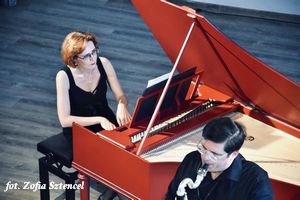
Ensemble: „Duo ClariCembalo”: Jakub Sztencel – clarinet and bass clarinet, Paulina Tkaczyk-Cichoń – harpsichord

Programme

J-X. Lefèvre, J.N.P. Royer, W. Ratusińska-Zamuszko, J. Cutler, P. Tkaczyk-Cichoń

During the concert, we will hear a fascinating blend of works encompassing a wide spectrum of musical styles – from the brilliance of the Baroque, through the Classical elegance of the 18th century, to modern compositions full of fresh, experimental sounds. The artists will take the audience on a journey through different eras, showcasing the versatility of the clarinet and harpsichord in both their traditional and contemporary roles. The programme features a selection of pieces with diverse characters, creating a captivating journey across centuries and styles. It will be an evening where the past meets the present, and listeners will discover new possibilities in the sound of both familiar and less commonly heard instruments.

Detailed programme

J-X. Lefèvre (1763-1829) Sonata in F major clarinet, b.c.
J.N.P. Royer (1705-1755) „Vertigo” (Premiere Livre) harpsichord solo
J-X. Lefèvre (1763-1829) Sonata in B-flat major clarinet, b.c.
W. Ratusińska-Zamuszko (*1977) „Nymphs II” clarinet, harpsichord
P. Tkaczyk-Cichoń (*1982) „Chaconne blues” harpsichord solo
J. Cutler (*1968) „Urban Myths” bass clarinet, harpsichord


11. „IN THE WORLD OF INSPIRATION – SAXOPHONE AND HARPSICHORD”

Performers

Ignacy Stojek – saxophone, Paulina Tkaczyk-Cichoń – harpsichord

Programme

M. Garson, J.S. Bach/Ch. Gounod, C. Bolling, J. Vanvinckenroye, P. Iturralde

This concert is an invitation into a world where different eras and styles naturally and freshly intertwine, creating music that is alive, unpredictable, and unique each time. It is a meeting of diverse timbres and musical worlds, built on original arrangements and improvisations inspired by the works of composers from various periods and styles. Early music becomes here a starting point for free interpretation and creative dialogue. The harpsichordist and saxophonist, mutually inspiring one another, create a unique atmosphere based on attentive listening and spontaneous exchange of musical ideas. An important element of the programme is also the incorporation of jazz language – blues and swing stylizations appear, while the inventive instrumentation unites everything into a coherent, contrast-rich musical narrative.

Detailed programme

M. Garson (*1945) „Jazz Variations on a Theme of Paganini” saxophone, harpsichord
J.S. Bach (1685-1750)/Ch. Gounod (1818-1893) „Ave Maria” saxophone, harpsichord
C. Bolling (1930-2020) „Baroque and Blue” saxophone, harpsichord
J. Vanvinckenroye (1939-2006) „Gioberney-Suite” saxophone, harpsichord
P. Iturralde (1929-2020) „Suite Hellénique” saxophone, harpsichord


12. „POLISH 20th AND 21st CENTURY MUSIC”

Performers

Marek Polański – violin, Natalia Jarząbek – flute, Beata Urbanek-Kalinowska – cello, Paulina Tkaczyk-Cichoń – harpsichord

Programme

W. Słowiński, M. Sawa, T. Frączkiewicz-Kirkov, R. Twardowski, A. Cwojdziński, M. Chyrzyński, K. Meyer

The 20th century and the early 21st century in Polish music is an incredibly diverse period, full of musical experiments, which, in spite of the difficult political situation contributing to a slowdown in the development of many disciplines, including music, haveled to the creation of new techniques and styles. For the composers of that era, the inspiration came from many sources. On the one hand, they drew from the romanticist tradition, impressionist paintings and folklore, on the other – from expressionism, with the attempt to create modern means of expression with classical balance, formulating the neoclassical style along the way, or moving towards atonality, which wrote off the prior order of sounds completely. The music of the 21st century goes against traditional aesthetic conventions in many dimensions, including melody, rhythm or chord progressions. This is precisely the reason why this concert’s programme is unique, because it connects all of these elements in an unusual instrumental line-up, and the composers whose works have been included are a symbol of Polish culture in the contemporary musical world.

Detailed programme

W. Słowiński (1930-2024) „4 Dialogues” violin, harpsichord
M. Sawa (1937-2005) „Burlesque” harpsichord solo
T. Frączkiewicz-Kirkov (*1953) „Fantasy” flute, violin, harpsichord
R. Twardowski (1930-2024) „Three etudes-capriccios”    violin solo
A. Cwojdziński (1928-2022) „Suite Op. 20” cello, harpsichord
M. Chyrzyński (*1971) „Haiku No. 3” flute solo
K. Meyer (*1943) „Concerto Retro” violin, flute, cello, harpsichord